FNSN @10 | Article 3 of 6
On the occasion of FNSN’s tenth anniversary, we sat down with the Founder Oyindamola Aina Adeniyi and asked her everything. This is what she said.
Before FNSN existed, what did a typical day look like for a family living with a neuromuscular condition in Nigeria?
“Every family has its own unique experience. But I can imagine that for many, their days were filled with questions and sighs.
Questions like “What is really happening to my child? Will it ever get better? What do we do next? And then the sighs after the fear, and the thoughts that seem to have no answers.
For those who are fortunate enough to get a diagnosis, the words from the doctors they trusted sometimes became the very sentence they never wanted to hear.
Beyond the diagnosis is the reality of living with the condition—the physical limitations, the emotional toll, and the financial burden. I know this because I lived it.”
What was the moment you decided to start FNSN?
“It was past 11 p.m. My younger brother called to say my mother could not leave her room to help him and my elder brother to the bathroom. She had suffered a partial paralysis. I was miles away.
I could not travel at that hour because it was too dangerous. So I prayed and waited until 5 a.m., then set out for Ogun State. On that bus ride, I started thinking about how muscular dystrophy was affecting all of us, not just my brothers, but my mother and me.
Then I thought about the many other families living through the same thing, silently, without anyone understanding them. That was when awareness stopped being just an idea. I knew I had to start speaking.”
Was there ever a point when you almost gave up?
“Give up? Those words were nowhere near my five senses. When I started, I only knew my two brothers as warriors. I found another on social media — a brother from Oyo State. I invited him to our first event on September 7, 2016. I promised to cover his transport. He promised to come.
For a few days, his number stopped going through. In December, someone finally picked up his phone. The news felt like ten million spears through my heart.
All I could say was, “Seye is late.”
He had died a few days before the event. Seye’s death rekindled something in me. Every loss made the fire in me burn even brighter.”
What does nobody see from the outside?
“Carrying the emotional burden of families who reach out to us. They come hoping their lives will become a little easier. But sometimes we cannot solve their challenges. Having to tell a parent, ‘We cannot do this for you right now,’ is never easy when you know exactly what they are going through. Behind the scenes, there are countless conversations, reassurance calls, follow-ups, and meetings. Sometimes the funding comes directly from our own pockets. People see the events and achievements. They don’t see everything that happens before and after.”
What has a warrior said to you that you will never forget?
“A warrior once asked me, ‘Oyin, you started this because of your siblings, and you have lost two already. If you lose the last one, will the foundation stop existing?’ I answered immediately. ‘The foundation cannot stop existing unless a cure has been found and I have reached all my siblings and had them cured. ‘That moment made me realise how much FNSN had grown beyond my personal story. My siblings are no longer the only reason I continue. I have found more siblings.”
What has been the hardest moment in ten years?
“In one sentence: every time I hear the words ‘Unfortunately, we have lost a sibling’.
Every warrior we lose feels personal. 2025 was the first year we did not record the passing of any of our warriors. I was incredibly grateful. I woke up on New Year’s Day grateful that we had made it through an entire year without that devastating call.
I believe 2026 will be the same.”
What has been the proudest moment?
“When the siblings in our support group banter with one another, share their experiences, and give each other suggestions. I see something bigger than FNSN providing support. I see warriors and caregivers supporting one another. People who once felt alone realising they are not alone. We have created a community where people can say: these are my people. They understand me.”
What does Nigeria still not understand about neuromuscular disease?
“That it can affect anyone, regardless of age, tribe, religion, or gender. Nobody chooses this.
I also wish we would move away from the belief that these conditions are connected to faith or prayers. These are genetic conditions. They are not a punishment or a curse. A warrior is still a whole person. Their diagnosis does not erase their intelligence, their dreams, their talents, or their desire to live a meaningful life.
Sometimes what hurts people most is not the disease itself but how society responds, the staring, the discrimination, the inaccessible buildings, and being excluded simply because they use a wheelchair.
Awareness is only the beginning.
We need better access to diagnosis, genetic testing, appropriate healthcare, assistive devices, rehabilitation, education, and employment opportunities.
“Above all, I wish Nigeria would see people living with neuromuscular conditions not as people to pity, but as people to include, protect, empower, and give the opportunity to thrive.”
If you could speak to one government official about rare diseases, what would you say?
“By ignoring those who suffer from rare diseases, Nigeria is squandering human and financial resources.
These Nigerians have potential as professionals, entrepreneurs, students, and inventors.
Every time a person with a rare disease is denied access to appropriate healthcare or education, Nigeria loses what that person could have contributed.
- Invest in diagnosis and genetic testing.
- Build policies that protect them.
- Involve them when you are designing policies that affect them.
You cannot create effective policies for a community you do not listen to.”
How has walking alongside warriors changed you?
“They have taught me that life is not guaranteed. Many warriors are told from a very young age they may not live to see a particular birthday. Imagine being given a timeline for your own life. Walking alongside them has taught me to live more consciously. To enjoy the moment. To appreciate the ordinary things we take for granted. My siblings have taught me not to postpone living.”
What do you want every warrior in Nigeria to know?
“I want you to know that you are my sibling. Even when you find it difficult to love yourself, I have enough love in my heart for you. You are not a burden.
You are not your wheelchair or your limitations. You are still you. You have dreams, talents, and something to contribute. You deserve to be seen, heard, and given the opportunity to live as fully as possible.
And to the warriors who have not found FNSN yet, you are not alone. I want you to live knowing that you matter.”
What does FNSN look like in 2036?
“I see FNSN’s care centre fully operational, safe, accessible, and dignified. But not just a place where warriors come to be cared for. A place where they learn skills, discover abilities, and contribute meaningfully to society. I also see caregivers having moments to breathe.
For many years they have carried enormous burdens with very little rest. I want a future where a parent can bring their child to our facility, know they are safe, and for a little while rest. Work. Sleep. Simply breathe.”
What is the one thing you still dream of doing?
“An accessible recreational park for warriors. A real place where they can simply have fun — merry-go-rounds, accessible swings, laughter, time with friends and family. We focus so much on care and survival that we forget they deserve to have fun too. If I could create a place filled with the giggles and laughter of warriors, I would consider that one of the most beautiful things FNSN has ever done.”
Ten years ago, if you could have seen FNSN today, what would the younger you have felt?
“Scared. As someone who struggled with anxiety, the younger me would have looked at everything and wondered how we got here.
I didn’t know the people I would meet, the warriors I would lose, or the challenges ahead. But she would eventually understand; we didn’t get here all at once. One conversation at a time. One warrior at a time.
One difficult decision at a time. One prayer at a time. And after the fear settled, she would look at everything FNSN is today and say:”
She did it. She kept going.
“And honestly, I think that would be enough.”
Oyindamola Aina Adeniyi is the Founder and Director of the Foundation for Neuromuscular Support Nigeria. FNSN celebrates ten years of impact on September 7, 2026.
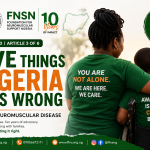
Coming next in the FNSN @10 series: What Nigeria Still Gets Wrong About Neuromuscular Disease.
Publishing: September 9, 2026.
Leave a Reply