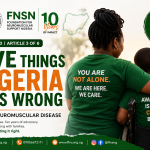
FNSN @10 | Article 4 of 6
In Nigeria, when a child stops walking, some families may turn to a church before a hospital.
It is not about blaming anyone. It is about recognising a reality many families face.
After ten years, FNSN has seen the gaps up close. We tell these stories because silence can leave families struggling alone.
Wrong Number One: It Must Be Spiritual
Nigeria is a deeply spiritual country, and there is nothing wrong with seeking faith and comfort.
The problem begins when spirituality becomes the only explanation for a medical condition.
Families living with muscular dystrophy and other neuromuscular conditions can spend years moving between churches, herbalists, and prayer houses before reaching a hospital. By then, the condition may have progressed significantly.
The condition was never spiritual. It was medical, and it had a name.
Wrong Number Two: Doctors Who Have Never Heard of It
This one is difficult to say, but it needs to be said.
Even families who reach hospitals may leave without a correct diagnosis. A child with progressive muscle weakness may be treated for something else, sent home, or asked to return months later.
Meanwhile, the child keeps losing strength.
For ten years, FNSN has worked to help bridge this gap by connecting families to information, support, and medical professionals who understand neuromuscular conditions.
Wrong Number Three: If It Is Rare, It Is Not Our Problem
The word “rare” can make a condition sound like someone else’s problem.
In Nigeria, it can mean limited awareness, limited research, few specialists, and families struggling to find where to turn.
“Rarity is not the same as invisibility. The people were always there. What was missing was awareness.”
— Oyindamola Aina Adeniyi, Founder and Director, FNSN
These families were always here. We simply have not looked closely enough.
Wrong Number Four: The Family Should Handle It Alone
In many Nigerian homes, illness is treated as a private family matter. You manage it quietly. You carry the burden and keep going.
But families need support too.
Parents get exhausted. Siblings carry worries they may never talk about. Warriors can grow up feeling like a burden.
FNSN exists because no family should have to figure everything out alone. Support groups and community have shown us what happens when families finally find people who understand them.
Wrong Number Five: There Is Nothing to Be Done
Hearing “there is no cure” can make a family feel like the conversation is over.
It isn’t.
Physiotherapy, respiratory support, assistive equipment, research, and other forms of care can still improve quality of life.
And there is community.
After ten years, FNSN is still here, reminding families:
You do not have to face this alone.
What We Are Asking For
1. Better medical education
Neuromuscular diseases should receive stronger attention in medical training so that healthcare professionals can recognise symptoms earlier and provide appropriate care.
2. Stronger institutional attention
Health agencies and policymakers must treat rare diseases as a serious public health concern and develop systems that support people living with them.
3. More responsible storytelling
The media should tell the stories of people with neuromuscular diseases with dignity, accuracy, and humanity, helping the public understand their realities beyond diagnosis.
4. Inclusive communities
Communities must move beyond pity and create spaces where people with disabilities can participate, contribute, and live with dignity.
5. Support for families
Families should have access to information, emotional support, and safe spaces to ask for help before the burden becomes overwhelming.
If you or someone you love is living with a neuromuscular condition, we are here.
Coming next in the FNSN @10 series: Open letter to warriors.
Publishing: September 12, 2026.

Leave a Reply